Chapter 1 — Introduction to Machine Learning
Learning from data
What to expect?
- overview over ML/AI
- basic understanding of most important ML methods and fundamental concepts
- experience how ML is done on a practical problem
What not to expect?
- instantly becoming an expert AI specialist / data scientist / ML researcher / statistician / ML software expert / domain expert
- learn about that newest hack you saw on blog xyz.
Course website
![]()
What is machine learning?
Machine learning (ML): algorithms that learn useful relationships from data.
- Conventional programs: rules specified explicitly.
- ML systems: some decision rules are estimated from examples.
- Goal: useful predictions on previously unseen inputs.
- Learning patterns ≠ human understanding or guaranteed correctness.
- What information is available, what do we want to predict, and how can examples help us make that prediction?
Learning rules from data
- Example: post-earthquake damage assessment.
- Input: photographs of buildings.
- Desired output: damaged or undamaged.
- Hand-crafted approach: color, shape, texture, and threshold rules.
- ML approach: learn parameters from labeled examples.
Question: Which patterns remain useful on new photographs?
Traditional programming versus learning
Rules versus learning
Training, testing, validation
Training: estimate model parameters
Given supervised examples,
\[
\mathcal D=\{(\mathbf x_i,y_i)\}_{i=1}^{n}
\]
- \(\mathbf x_i\): input; \(y_i\): known target/label.
- Learning algorithm updates parameters \(\mathbf w\).
- Trained model: \(f(\mathbf x;\mathbf w)\).
Training asks: How do we estimate a model from examples?
Training, testing, validation
Inference and evaluation are not training
Inference — predict on a new input
\[\hat y=f(\mathbf x_{\mathrm{new}};\mathbf w)\]
- The correct target does not need to be available.
Evaluation — measure predictive performance
- Compare predictions with known targets.
- Prefer held-out, previously unseen data.
Three distinct questions: learn? predict? reliable?
A first classification model
Post-earthquake damage assessment
Binary task: damaged vs. undamaged buildings
- Input: building images.
- Data: labeled photographs that belong to one of two classes.
- Training: estimate a classification rule.
- Inference: apply that rule to a new image.
- Output: building class.
- Underlying steps: pixels → numbers → score → class.
Building damage classification
What an update can—and cannot—do
- A wrong prediction provides a signal to change weights.
- Updating one example may affect predictions for others.
- A perfectly separating hyperplane may not exist.
- Related to stochastic subgradient learning for a perceptron loss.
Central idea: prediction error drives parameter adaptation.
Machine learning is interdisciplinary
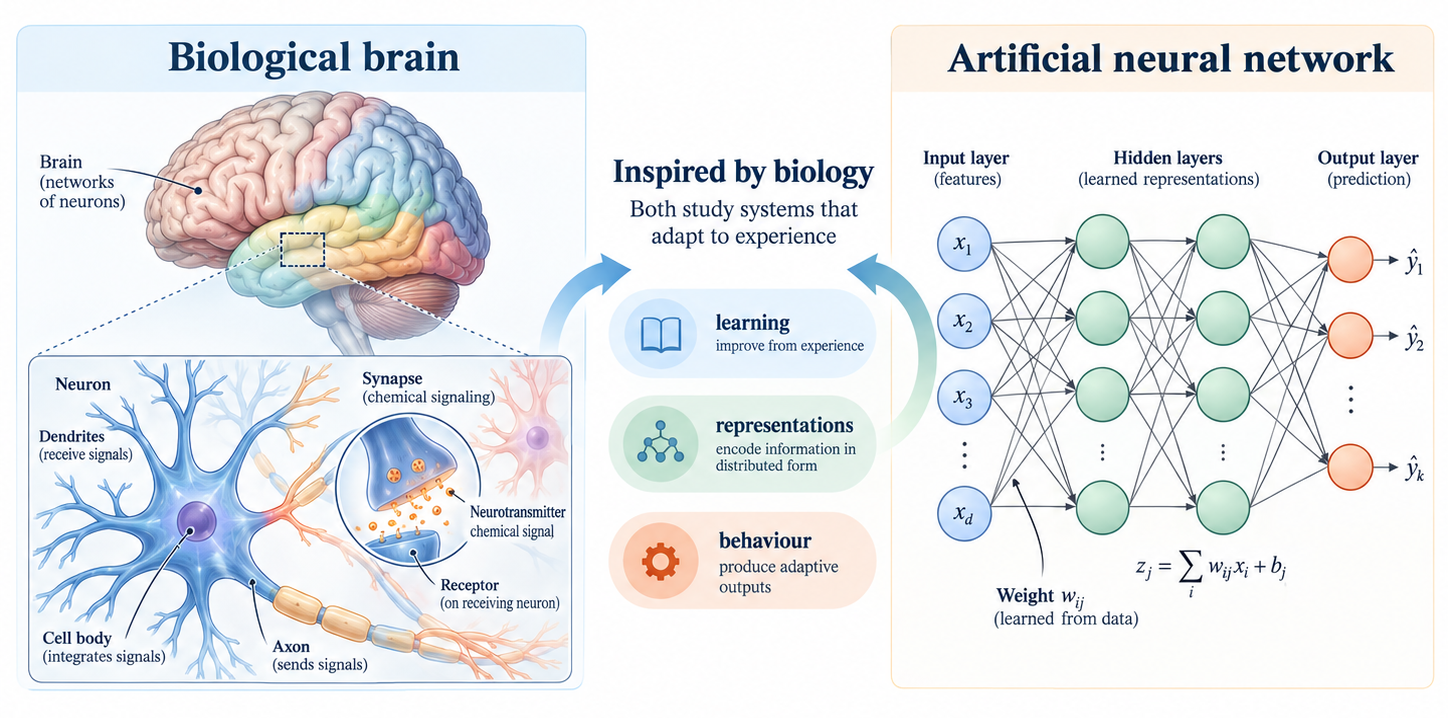
Artificial versus biological neural networks
- The name neural network is inspired by neuroscience.
- Artificial neuron: numerical weighted operations.
- Biological neuron: complex electrical and chemical processes.
- Both concern adaptive systems—but mechanisms are not equivalent.
![]()
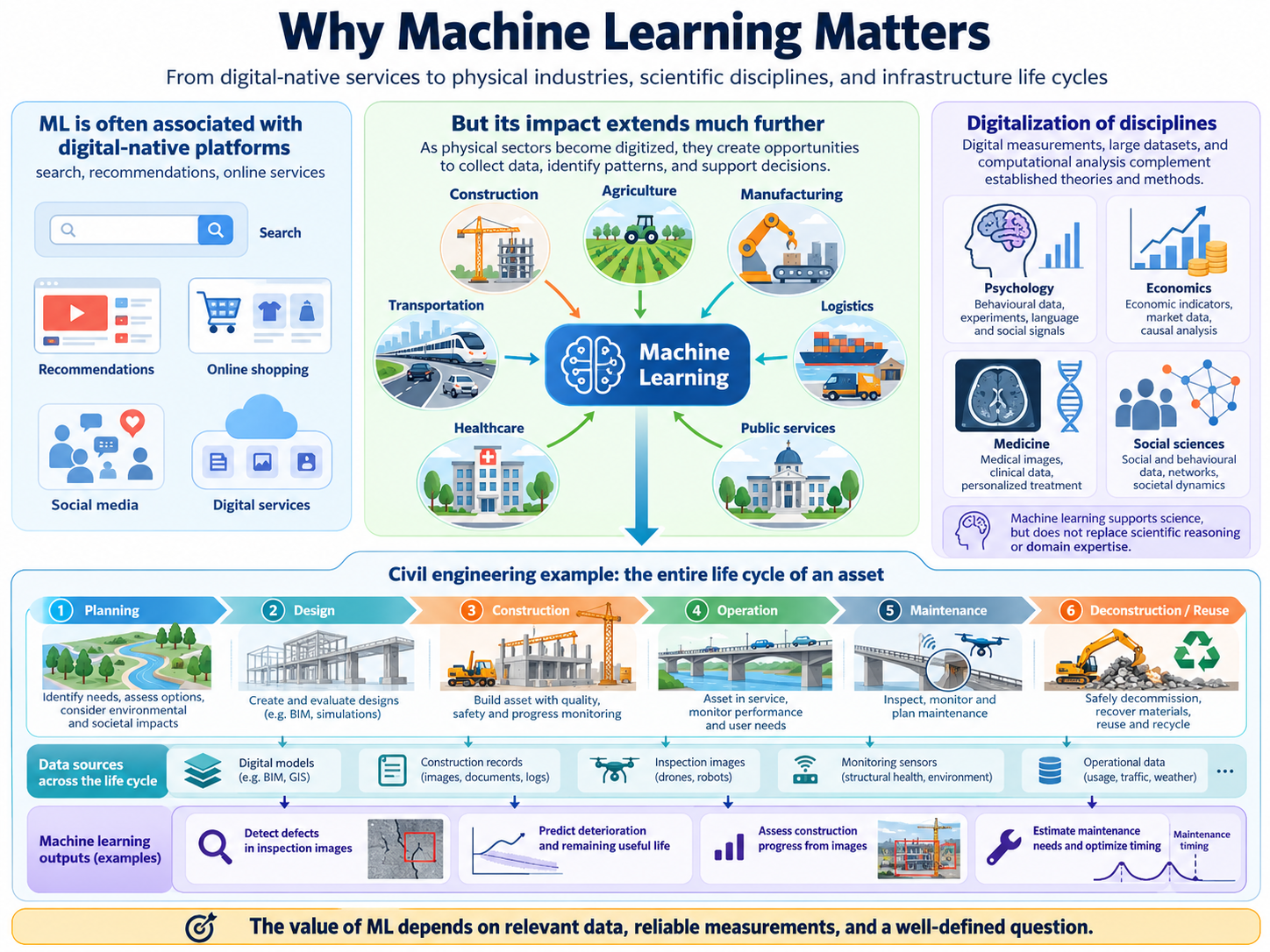
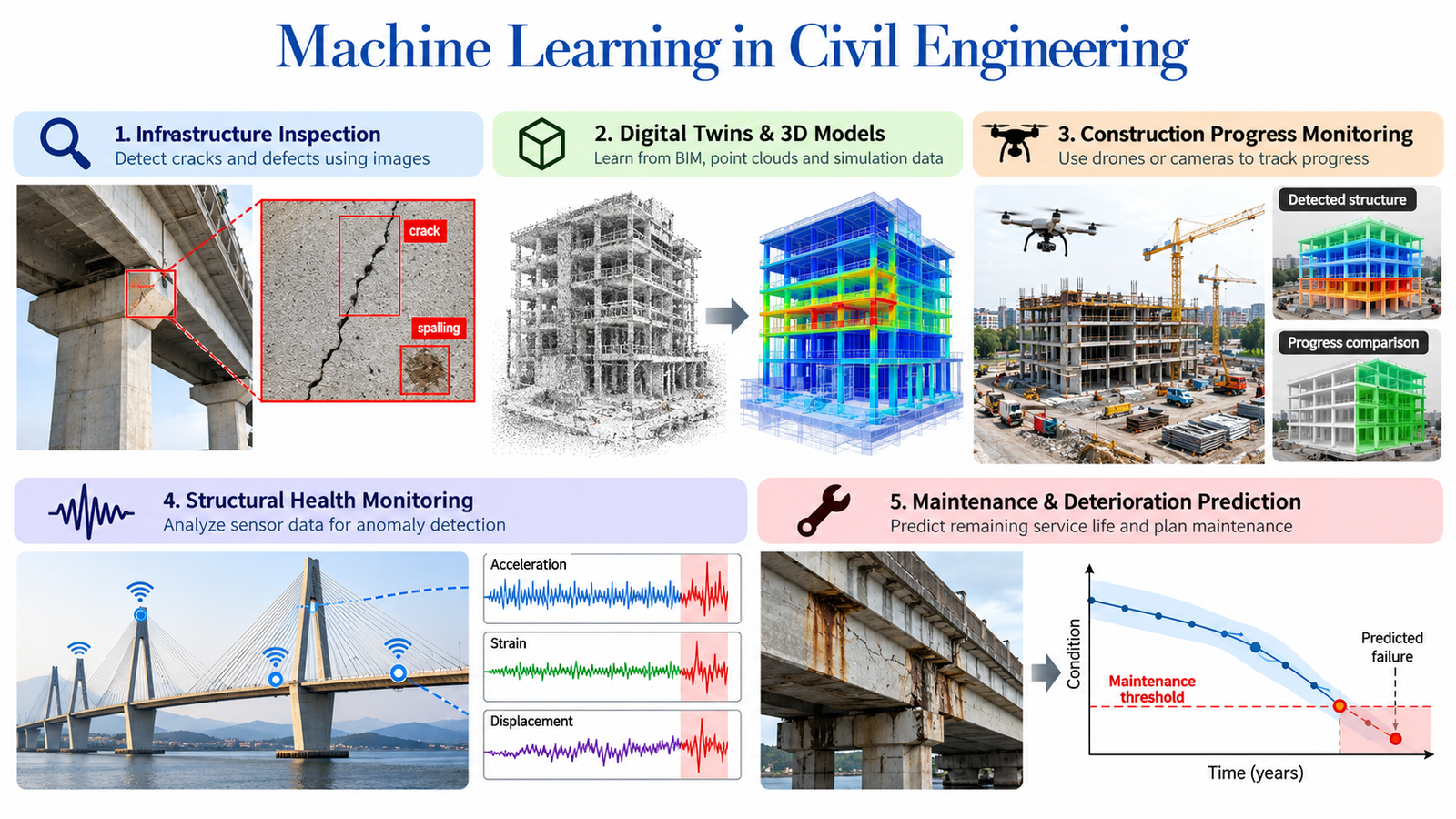
Why machine learning matters
![]()
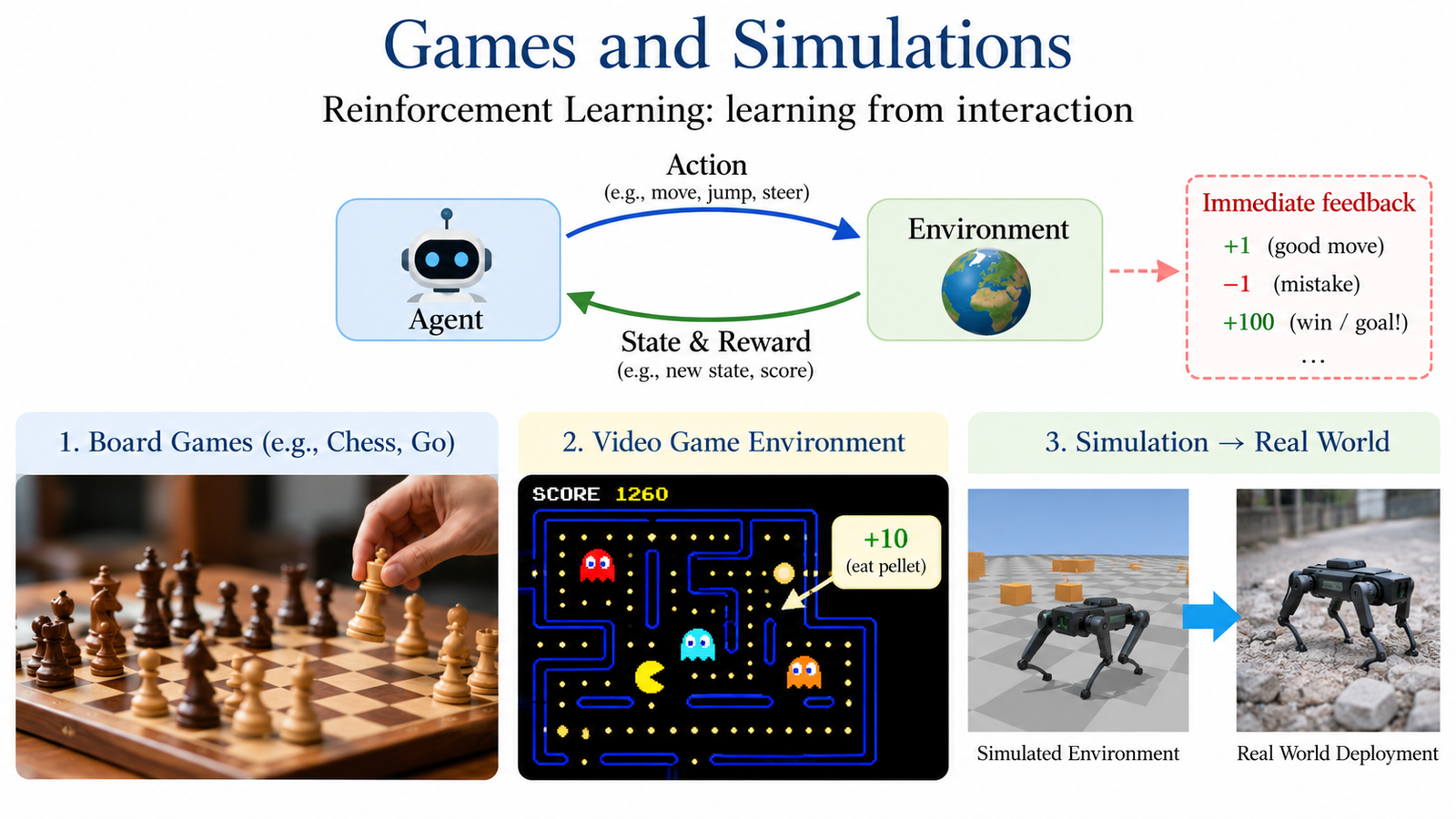
Why machine learning matters
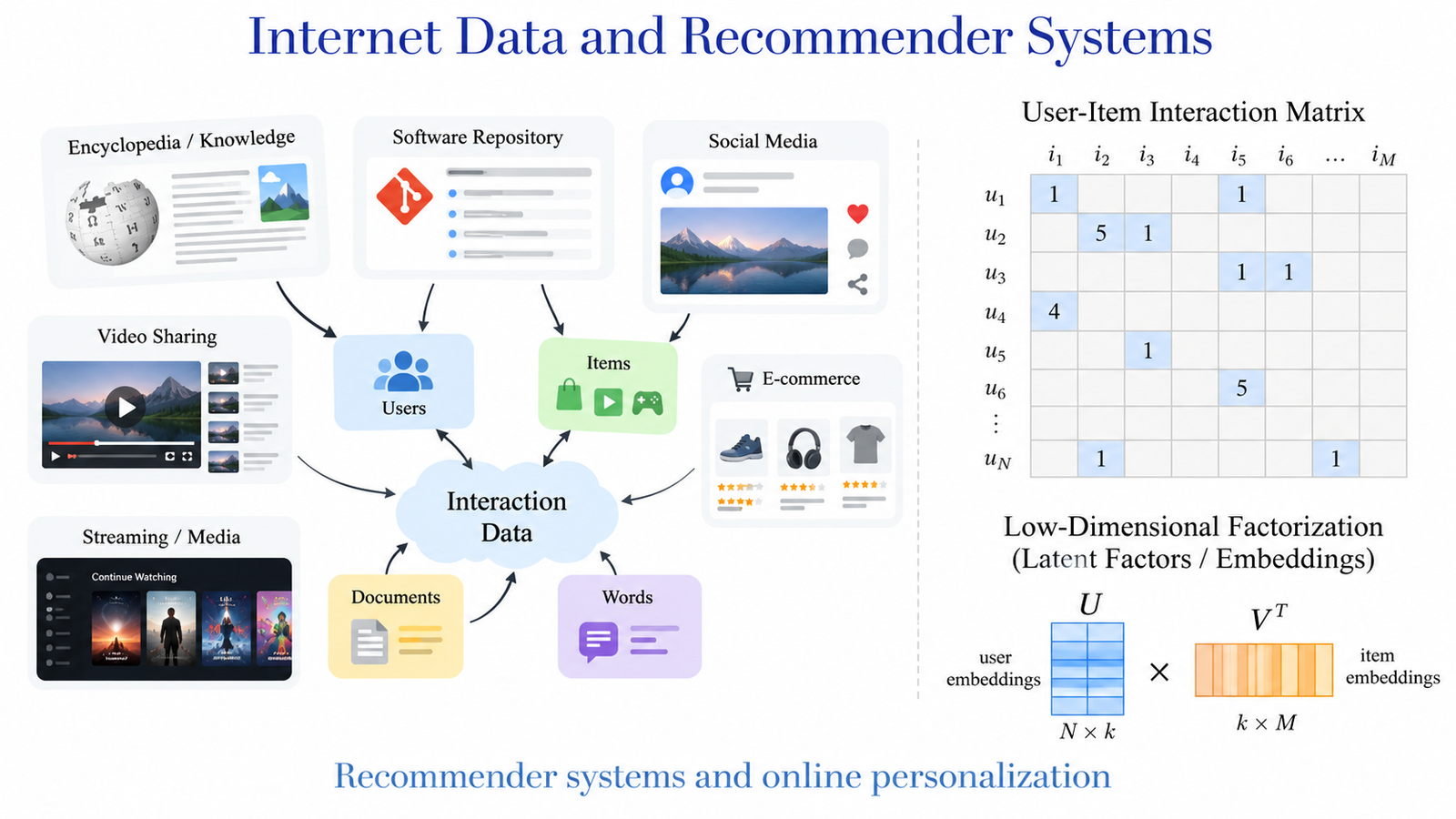
![]()
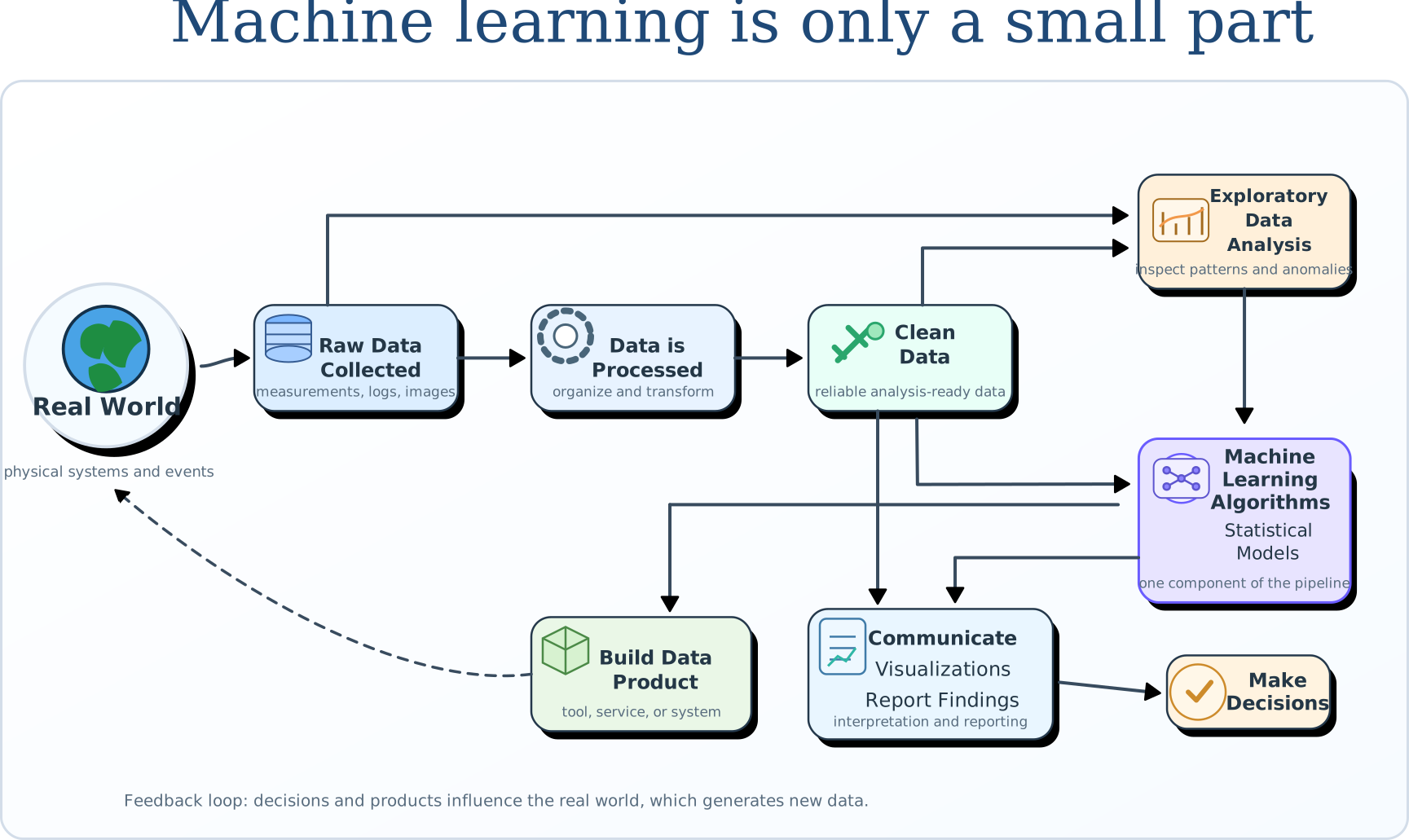
A good model is not enough without reliable data and useful decisions.
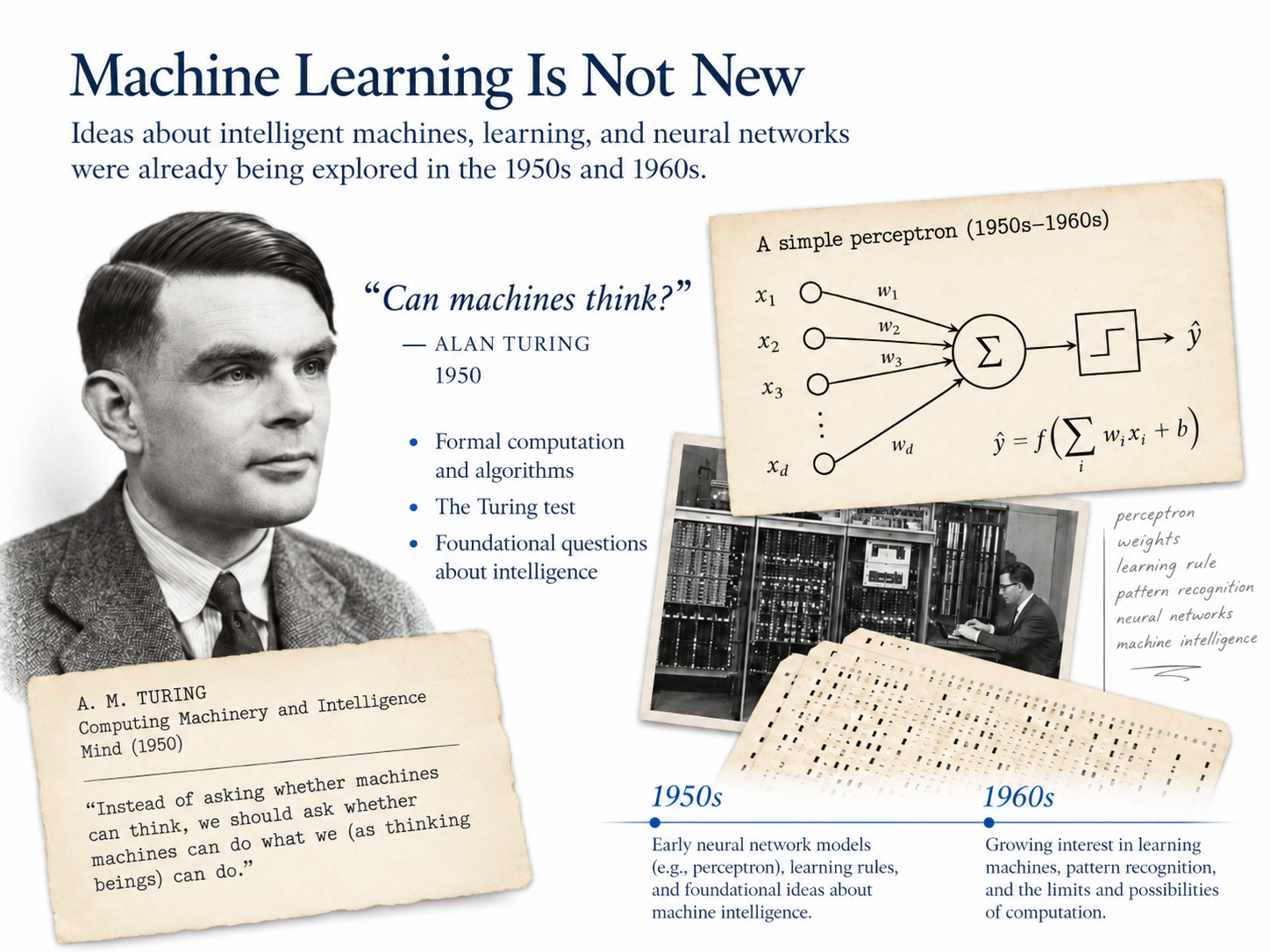
Origins: learning from observations
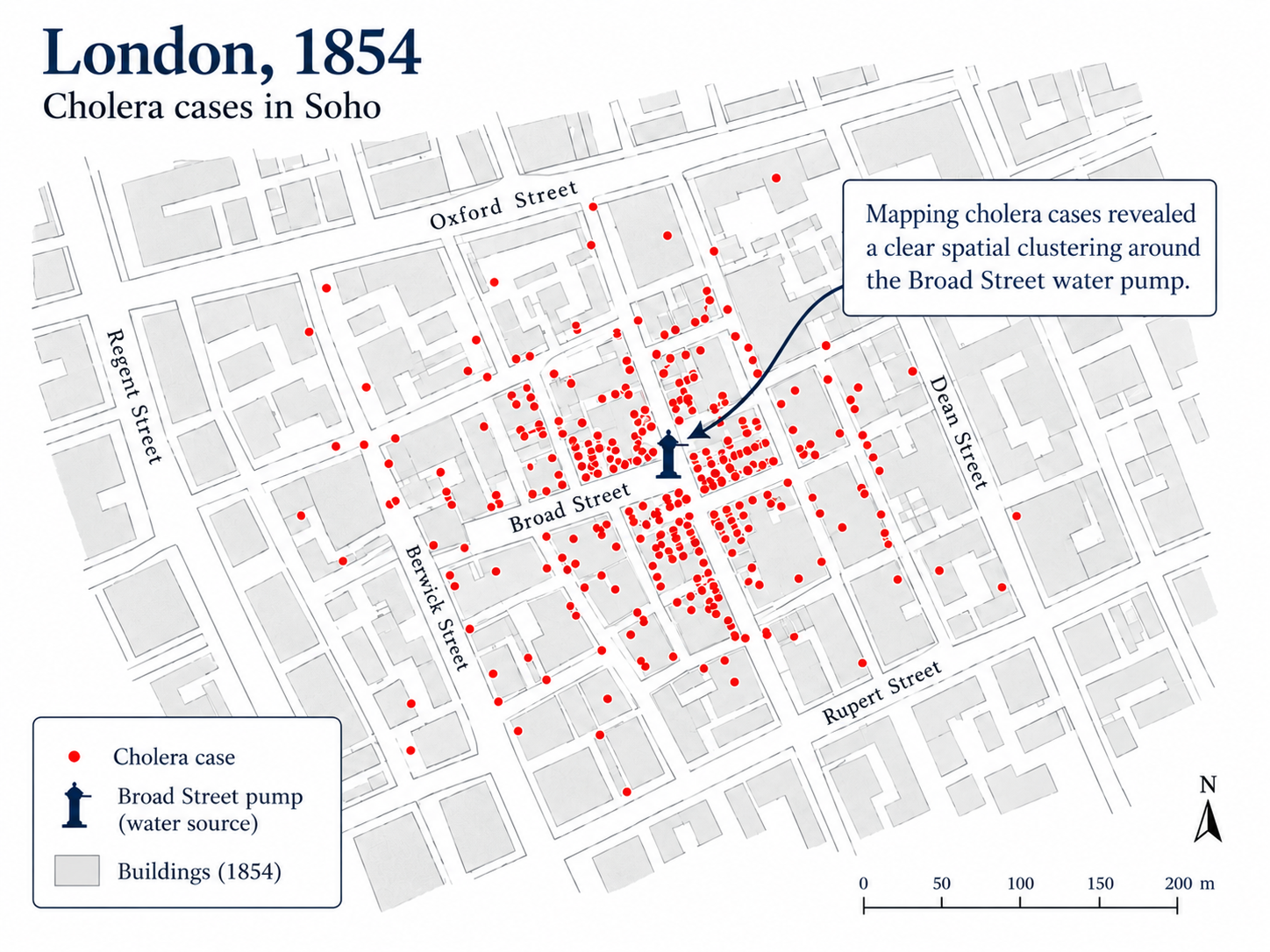
John Snow and the 1854 London cholera outbreak
![]()
Pre-ML lesson: data patterns can guide scientific hypotheses.
Foundations of modern AI and ML
![]()
- Durable ideas: numerical representations, learning rules, prediction.
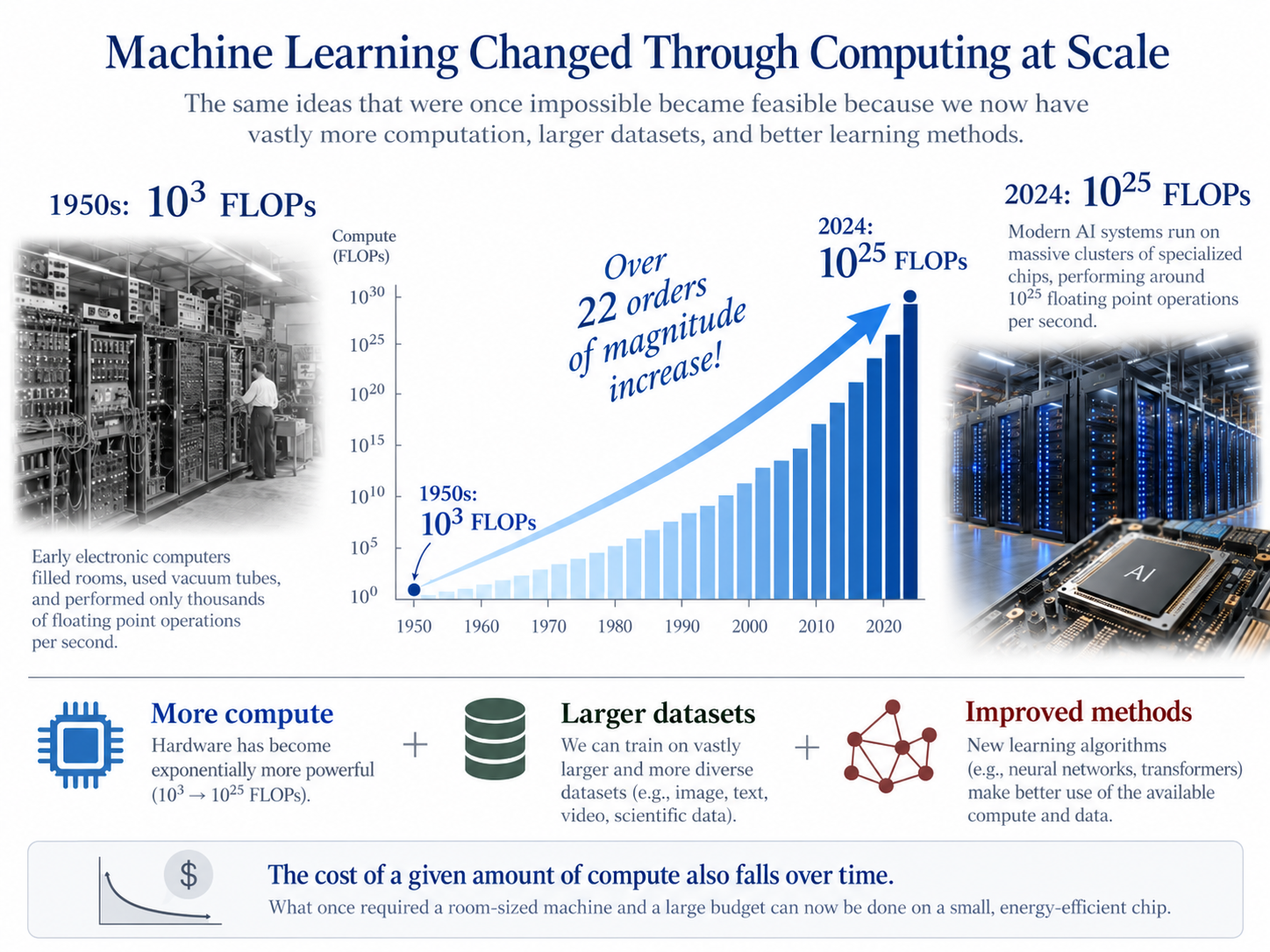
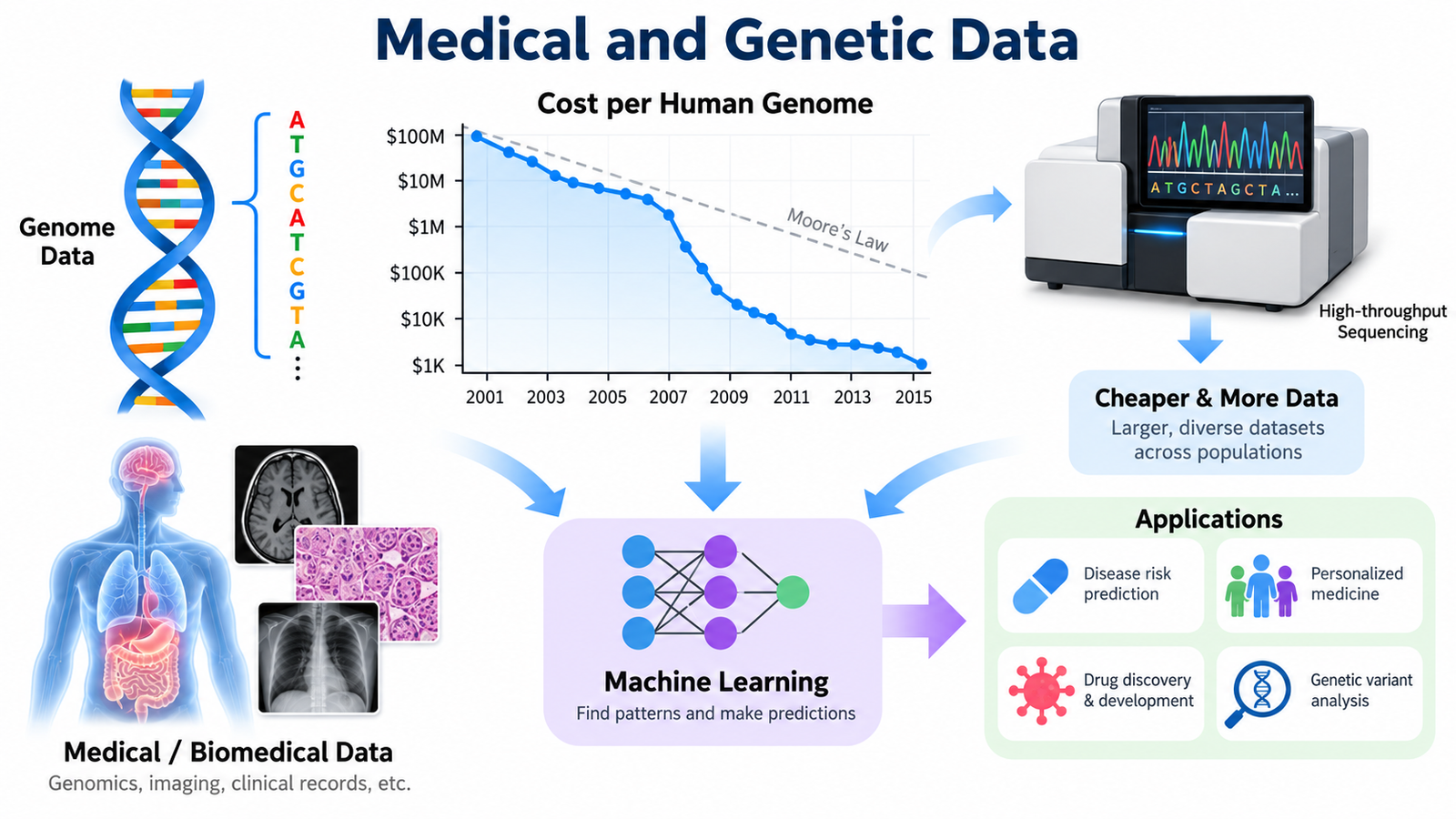
What enabled recent progress?
Three interacting developments:
Computing capacity — vastly increased. Digital datasets — larger and more accessible. Algorithms — more effective and efficient. ![]()
Challenges of ML
Hype versus real-world reliability
- AI has experienced cycles of enthusiasm and disappointment.
- A convincing demonstration is not proof of reliable deployment.
- Ask: What assumptions were made? On which data was it tested?
- Performance must be judged in its application context.
Data, privacy, and fairness
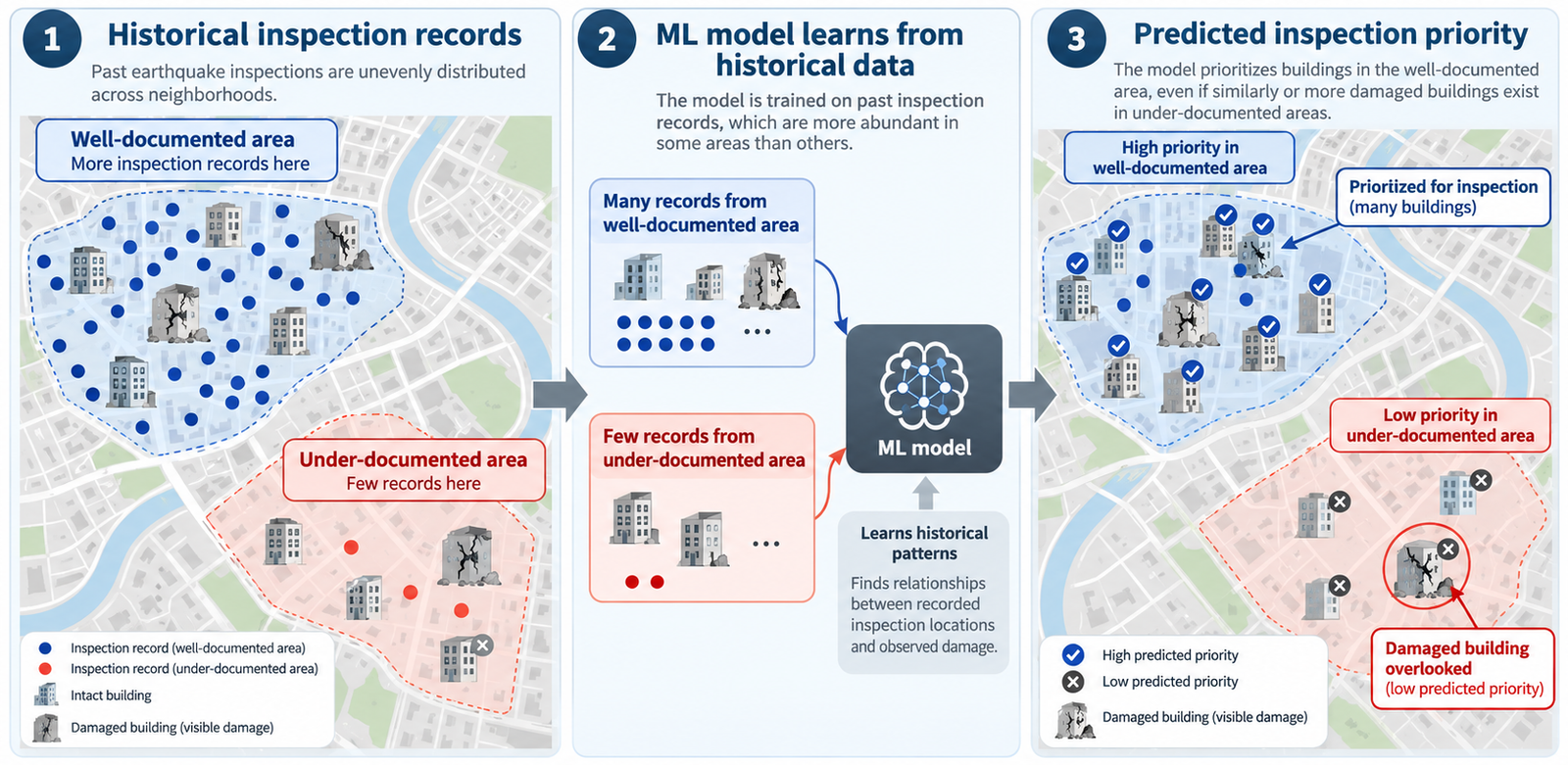
- Datasets reflect collection, labeling, and historical decisions.
- Observed patterns can be biased or unrepresentative.
- A model can reproduce unfair outcomes without an explicit unfair rule.
- Privacy and data governance are part of system design.
Challenges of ML
Example: biased post-earthquake inspections
![]()
Evaluate coverage, representativeness, and consequences.
Challenges of ML
Interpretability and societal impact
- Simple rules may be transparent; deep models can be harder to explain.
- High-stakes domains need reliability and physical plausibility.
- AI affects work, education, information, and access to services.
- Potential misuse: misinformation and harmful automation.
- Longer-term safety and governance questions remain under debate.
Building trustworthy ML
- Follow the scientific method and evaluate reproducibly.
- Document training data, assumptions, and limitations.
- Use transparent benchmarks and independent validation.
- Openness helps reproducibility—but balance with privacy, licensing, and safety.
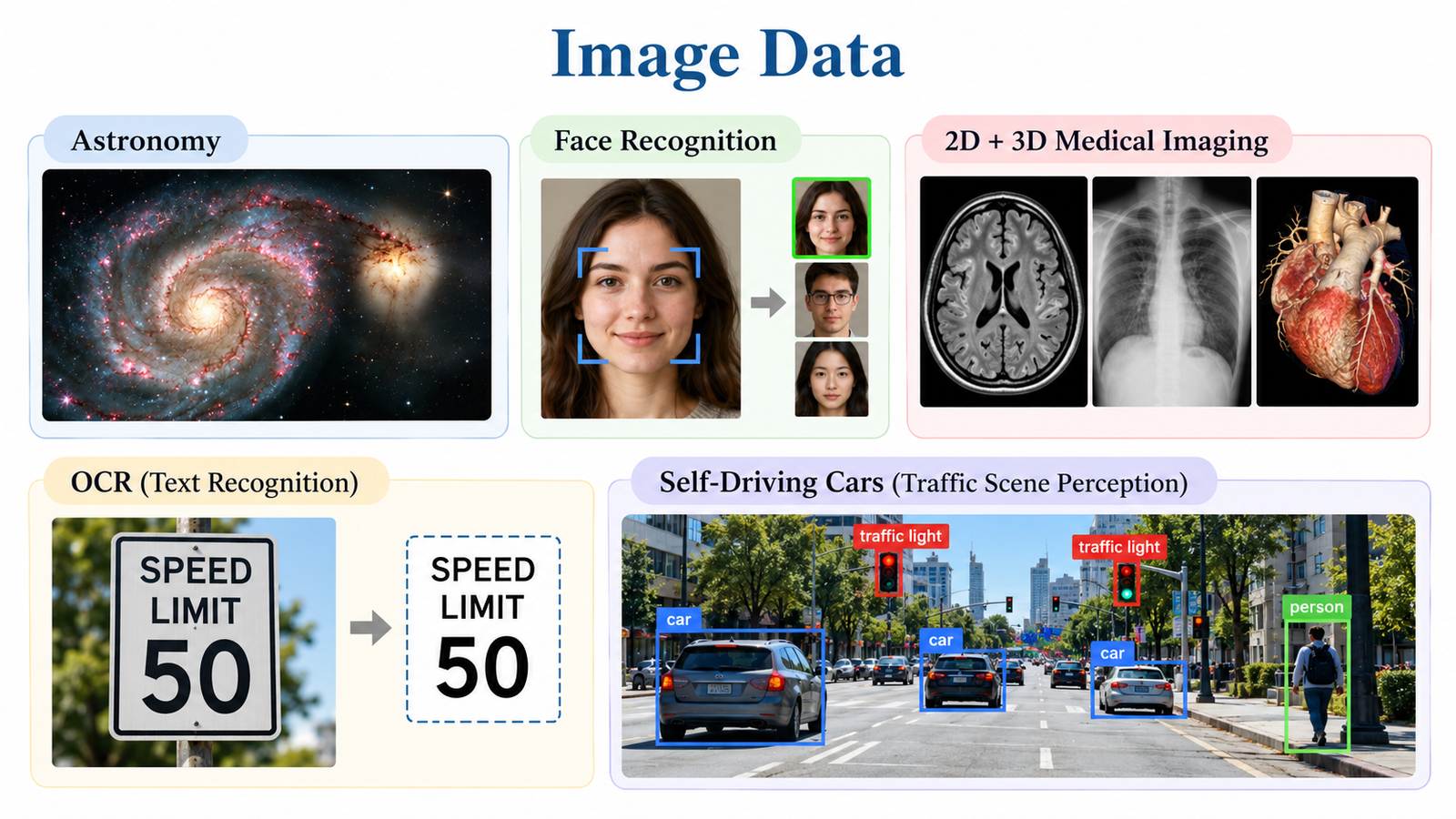
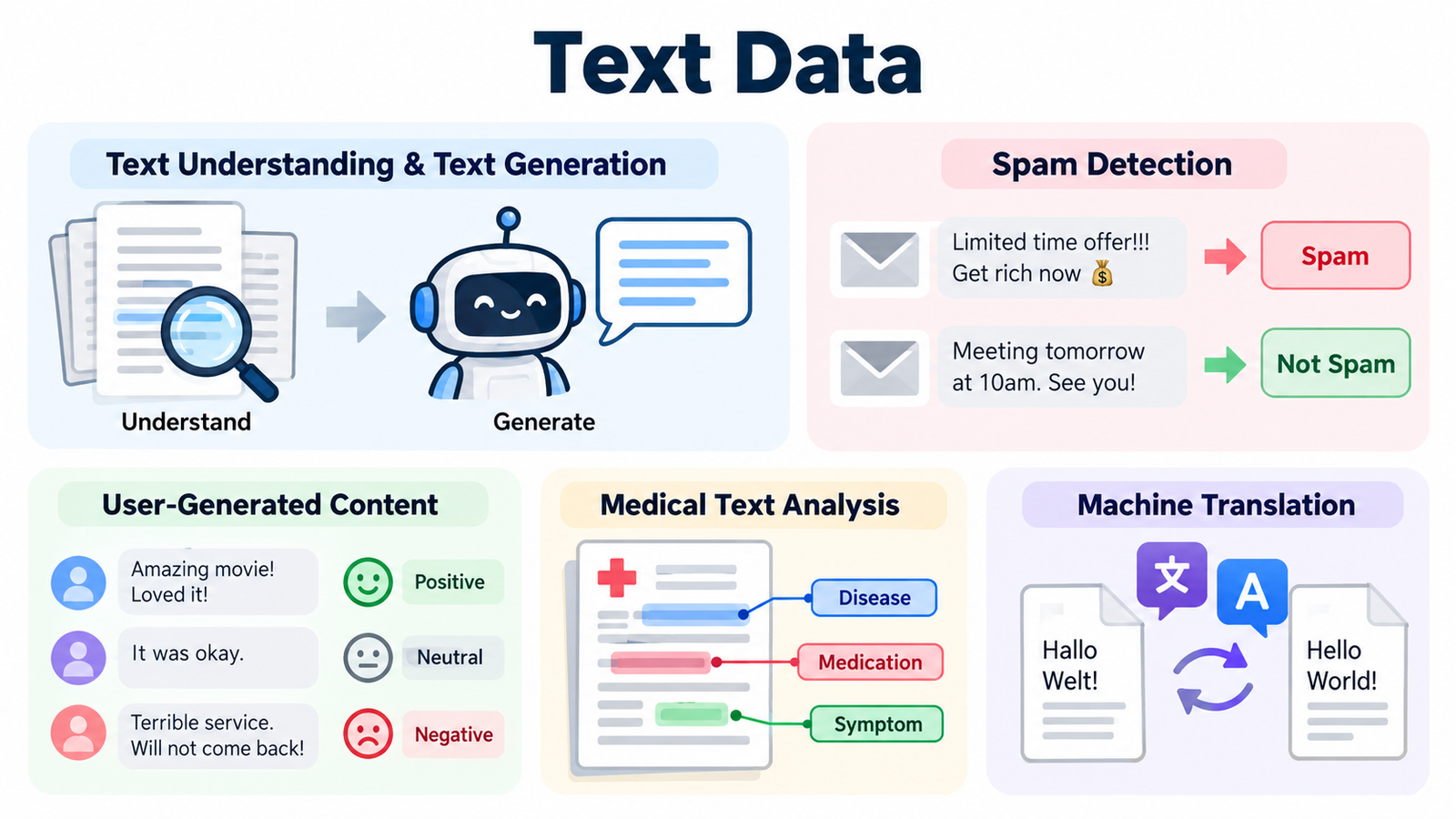
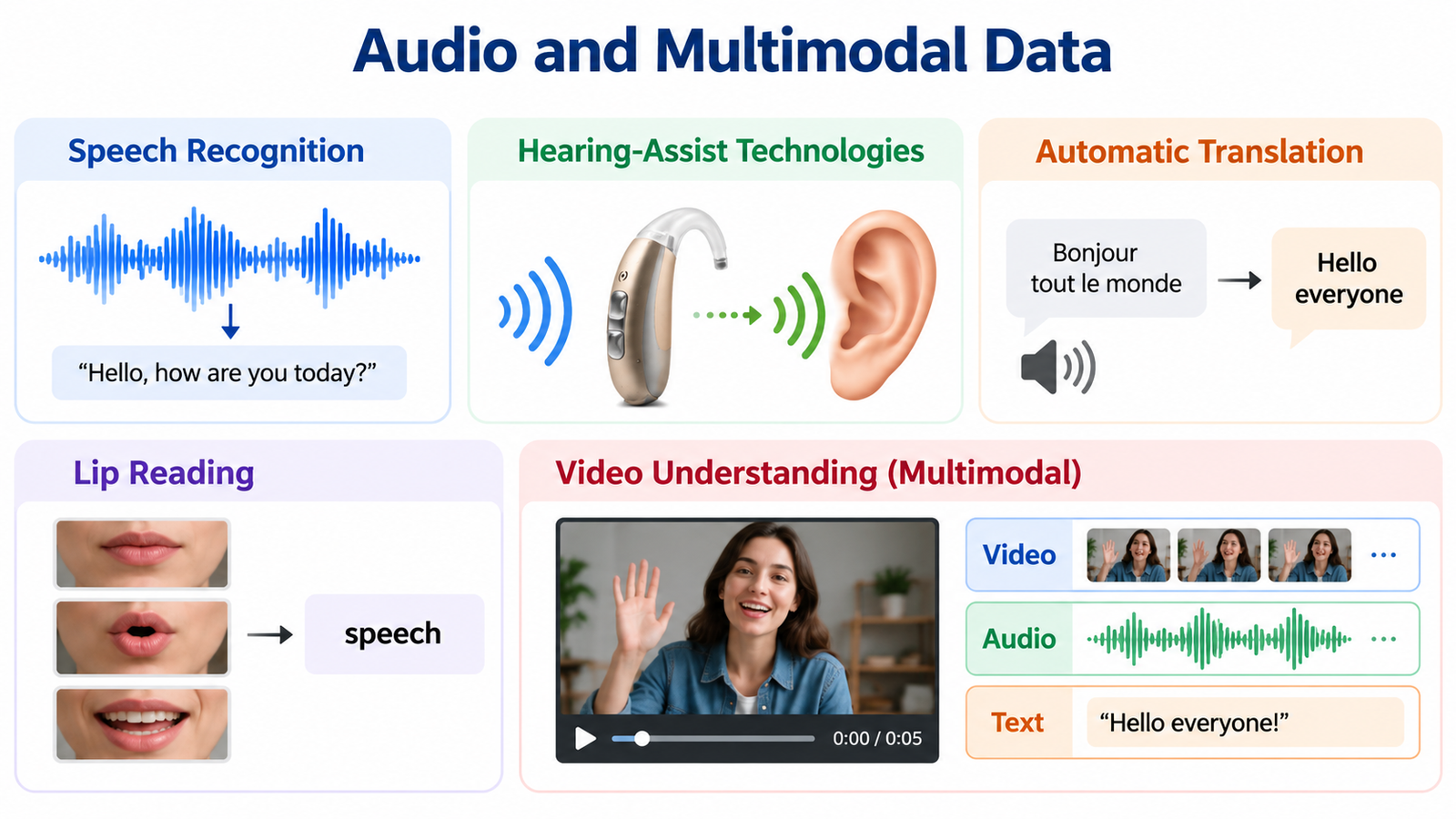
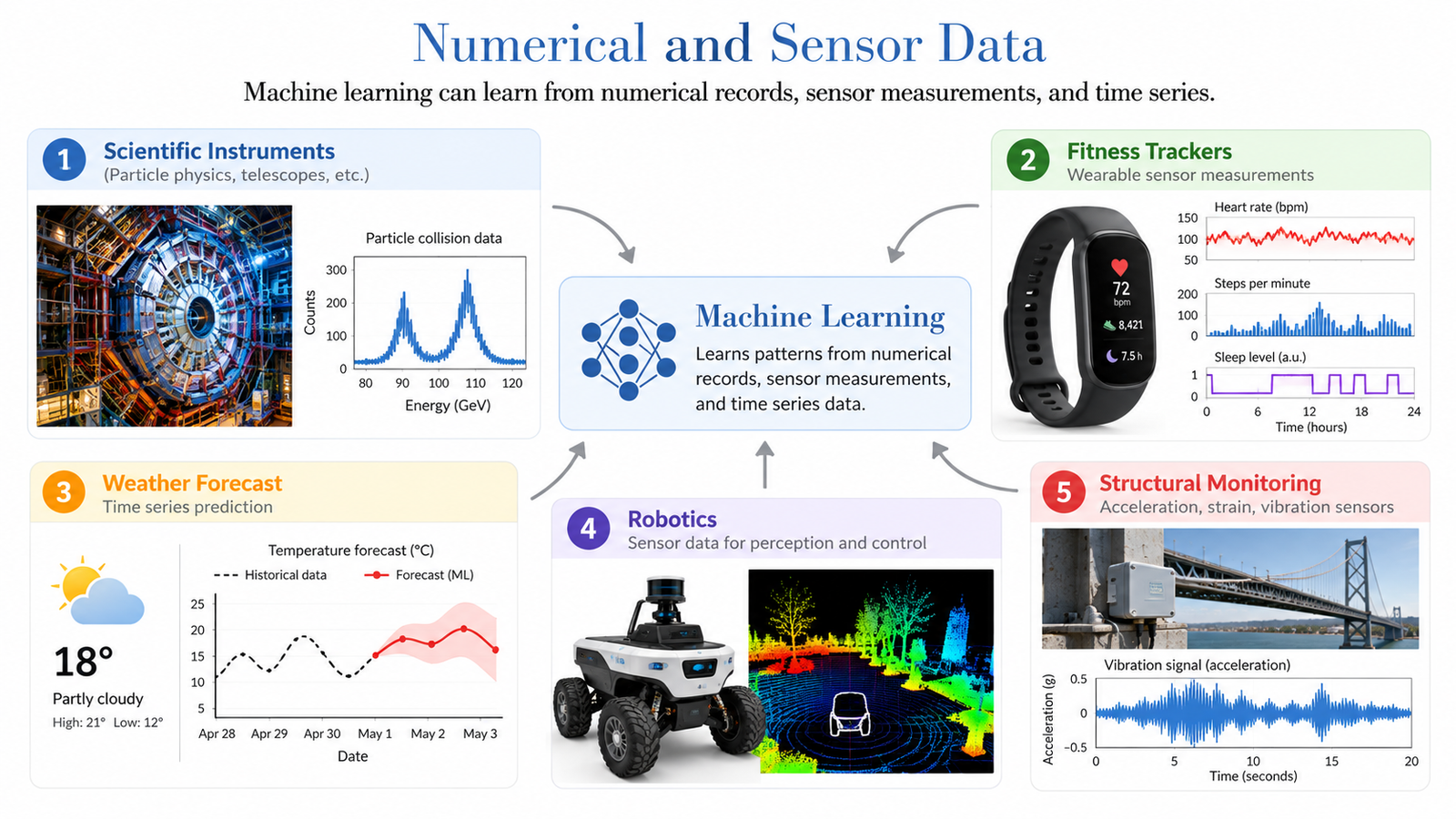
Data modalities and modern applications
- Different data can be represented numerically.
- Task depends on input data and desired output.
- Outcomes include classes, regions, numbers, sequences, and actions.
Next: different forms of data—and the problems they make possible.
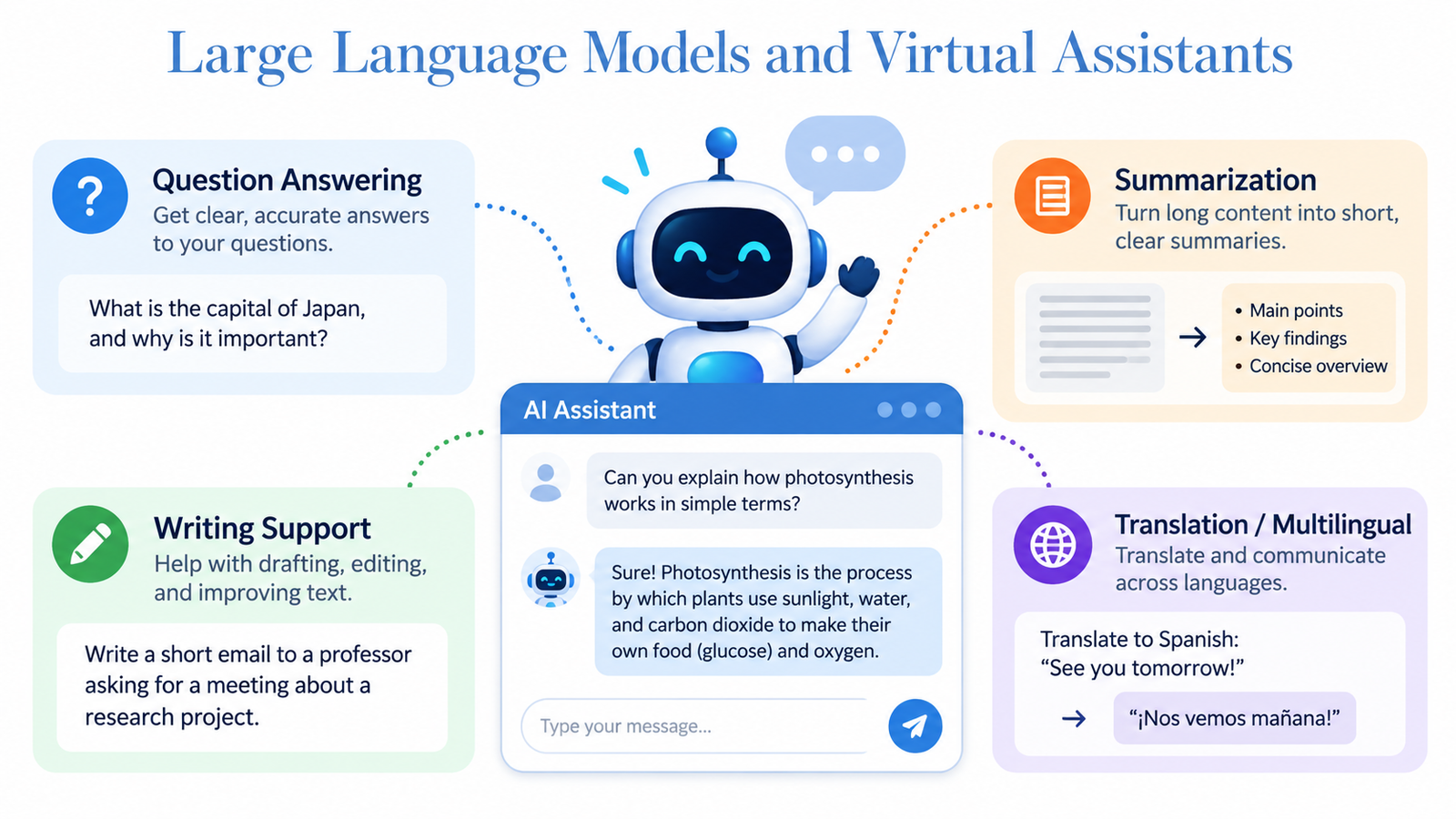
Digital text makes large language models possible
- Train on extensive collections of digital text.
- Learn relationships between tokens and context.
- Adapt for tasks: Q&A, translation, summaries, coding.
- Powerful outputs can still be plausible but inaccurate.
![]()
Language models and generative AI
Large language models (LLMs)
- Learn statistical patterns of human language.
- Trained on large text collections with many parameters.
- Many use next-token prediction as a central training objective.
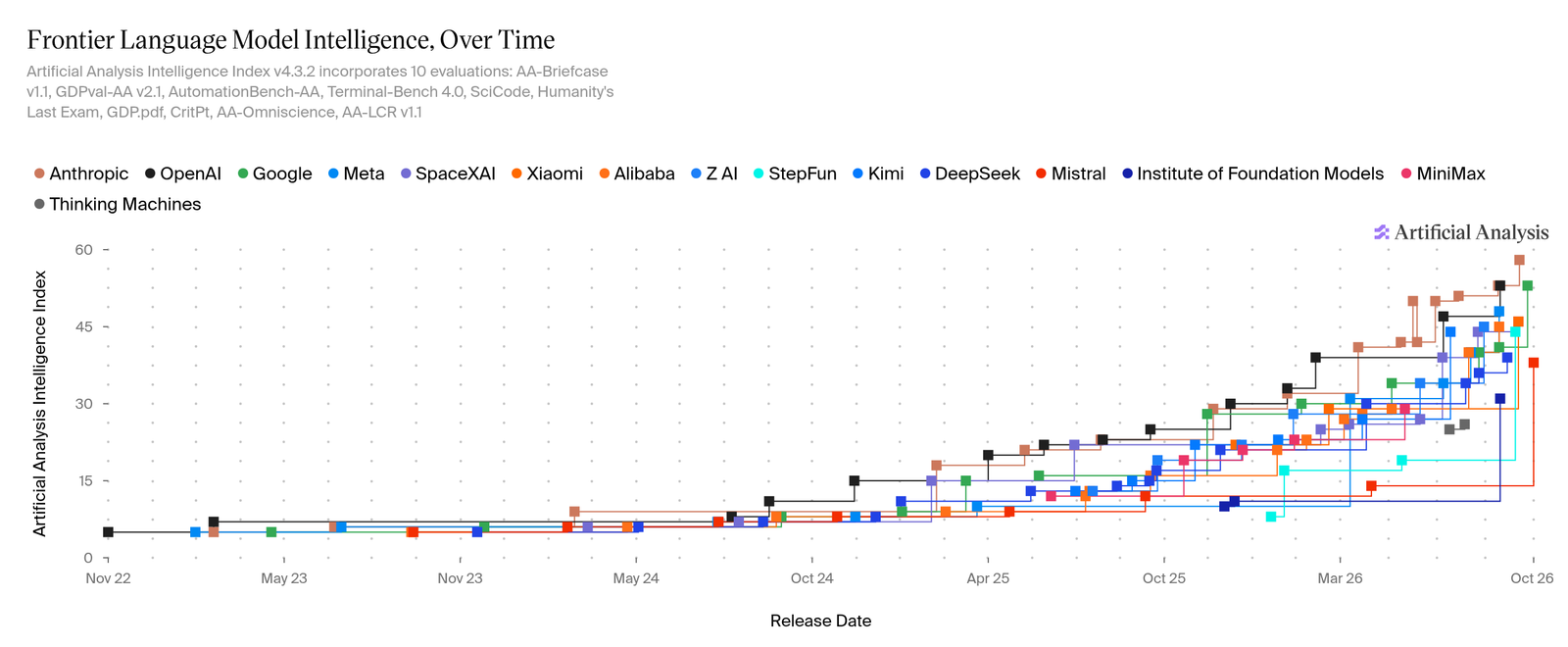
Language-model capabilities over time
![]()
Source: Artificial Analysis, Frontier Language Model Intelligence, Over Time (accessed 12 October 2026). https://artificialanalysis.ai/#frontier-language-model-intelligence-over-time
Generative AI goes beyond text
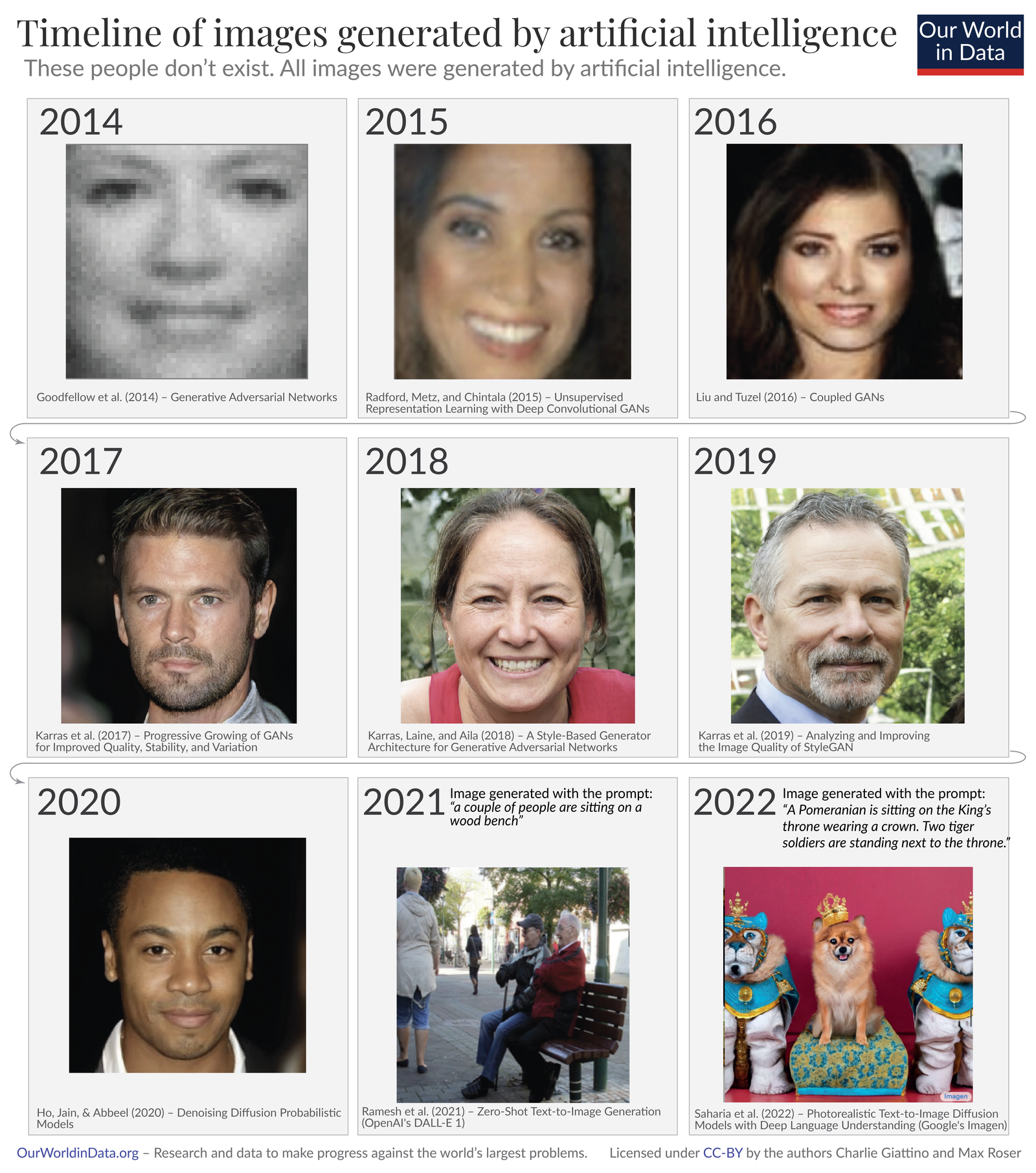
- Image generation: new images from text prompts.
- Audio: synthetic speech and music.
- Video: generated moving scenes.
- Other representations: 3D data and multimodal content.
![]() Source: Max Roser (2022), The brief history of artificial intelligence: the world has changed fast — what might be next?, Our World in Data. https://ourworldindata.org/brief-history-of-ai
Source: Max Roser (2022), The brief history of artificial intelligence: the world has changed fast — what might be next?, Our World in Data. https://ourworldindata.org/brief-history-of-ai
Generating plausible content ≠ being correct
- Generative models learn patterns and produce new content.
- Outputs may appear convincing but be factually wrong.
- Validate outputs for scientific, technical, and safety-critical uses.
- Responsible use requires knowing strengths and limitations.
From opportunities to meaningful ML problems
Ask before choosing an algorithm:
- What decision or prediction would be useful?
- Which inputs exist at prediction time?
- Can we obtain reliable targets?
- How will success be measured on unseen cases?
- What are the costs of errors?
Example: infrastructure inspection and maintenance
- Possible outputs: damage class, crack width, deterioration, priority.
- Inputs: photographs, sensor data, weather, inspection history.
- Labels: observed damage categories or measured conditions.
- Evaluation: unseen structures, representation, consequences.
Engineering value depends on more than predictive accuracy.
From an application to a mathematical model
- Inputs \(\mathbf x\) and outputs \(y\) define a learning problem.
- A model \(f(\mathbf x;\mathbf w)\) makes predictions.
- A loss function quantifies prediction errors.
- Optimization adjusts parameters to reduce loss.
- Generalization asks whether the model works on new cases.
Machine Learning Mini-Project
Open topic: any domain, dataset, input type, or suitable ML model.
- Define a problem: choose or create a dataset; identify inputs and desired outputs.
- Build a model: prepare data, train, and evaluate on unseen examples.
- Demonstrate: provide a runnable prediction/test workflow (script or notebook is fine).
Submit
- GitHub repository with a README explaining setup, data access, retraining, testing, and results.
- 2-page LaTex report: problem, approach, main findings, lessons learned, and relevance to your field.
Priority: clear problem + reproducible workflow + meaningful evaluation. No web app or novel algorithm required.
Coming next — regression and linear regression
- Represent input–output relationships with mathematical functions.
- Define predictions and measure errors with loss functions.
- Use optimization to adjust model parameters.
- Examine model fitting and generalization.
Simple regression models provide foundations for more advanced ML.
Acknowledgements and AI Disclosure
Acknowledgements
- Developed with reference to CS-433 Machine Learning, École Polytechnique Fédérale de Lausanne (EPFL).
- Adapted and extended for the present course, including civil engineering applications.
- Independent teaching materials; no EPFL endorsement is implied.
- Original EPFL course
Use of Generative AI
- AI-assisted drafting, editing, examples, figures, and interactive visualizations.
- The instructor is responsible for the final content and technical accuracy.
- External materials are acknowledged separately.

 Source: Max Roser (2022), The brief history of artificial intelligence: the world has changed fast — what might be next?, Our World in Data. https://ourworldindata.org/brief-history-of-ai